
Blog
Antec AI Mini PC Lineup Lands in Algeria

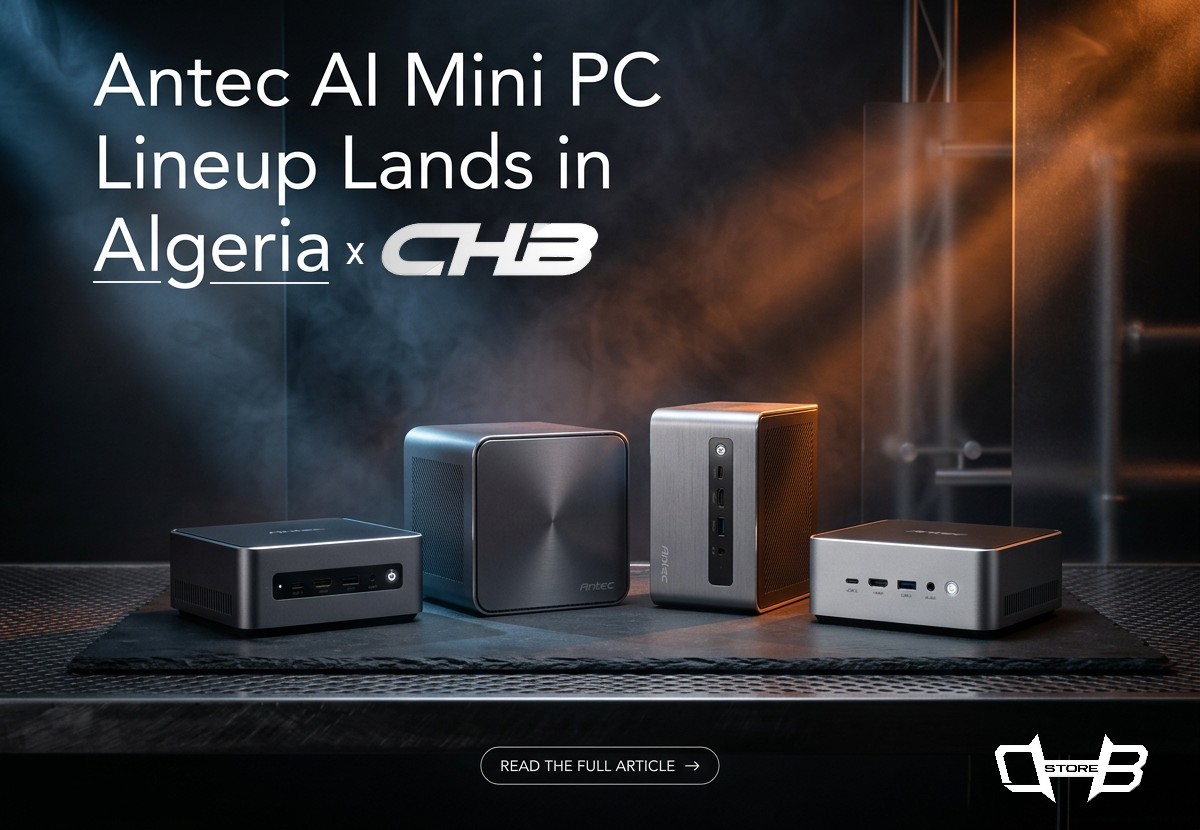
While the world fights over a single stick of RAM, Antec offers another path: AI power, right-sized, packaged, and soon landing in Algeria.
The context: a global shortage that’s changing the rules
Let’s be blunt: 2026 will be remembered as the year RAM became a luxury good. What cost around a hundred dollars a year ago can now cost several hundred — some 32GB DDR5 kits have jumped from $70-120 to over $375 in just a few months, and 64GB kits are now flirting with $600, more expensive than a game console. The manufacturers themselves — Samsung, SK Hynix, Micron — have stopped offering fixed pricing, choosing instead to redirect their fabs toward high-bandwidth memory (HBM) devoured by AI data centers rather than consumer RAM.
The result: memory, a component nobody used to think twice about, has become the bottleneck of the entire PC industry. And analysts aren’t expecting relief before 2027, or even 2028 according to Micron.
In this climate, building your own machine tailored for AI — with enough unified memory, a capable GPU, and a stable platform — has become a budgetary minefield, especially for a project founder or a young startup in Algeria, where general inflation was already unforgiving enough on its own.
That’s exactly the gap Antec is stepping into.
Antec enters the AI race: three lineups, three budgets, one ambition
Antec, one of the brands represented by CHB in the Algerian market, is announcing the arrival of its brand-new family of AI-dedicated Mini PCs. Rather than offering a single « one-size-fits-all » machine, the brand has taken a segmented approach, built to match very different needs and budgets:
| Series | Positioning | Who it’s for |
|---|---|---|
| Core Apex (395 / 388) | High-End | Local AI development, 70B+ LLMs, 3D creation, high-res gaming |
| Core Pro (470 / 450) | Mid-Range | Content creators, professionals, creative AI workflows |
| Core One (304 / 403) | Value / Accessible | Everyday office work, SMBs, large-scale deployment, light Copilot+ AI |
It’s an almost obvious reading of where the Algerian market stands right now: not everyone is jumping into AI with the same means, and not everyone needs the same horsepower. A startup training models or running an LLM locally doesn’t have the same needs as an accounting firm looking to automate a bit of paperwork with embedded AI. Antec answers both — and everything in between.
The technical breakdown: what’s actually under the hood
Let’s talk numbers, because that’s also what decision-makers want to see before signing a purchase order.
| Spec | Core One 403 (Value) | Core Pro 470 (Mid-Range) | Core Apex 395 (High-End) |
|---|---|---|---|
| Processor | Intel® Core™ 3 403 | AMD Ryzen™ AI 9 HX 470 | AMD Ryzen™ AI Max+ 395 |
| Graphics | Intel® UHD Graphics | AMD Radeon™ 890M | AMD Radeon™ 8060S |
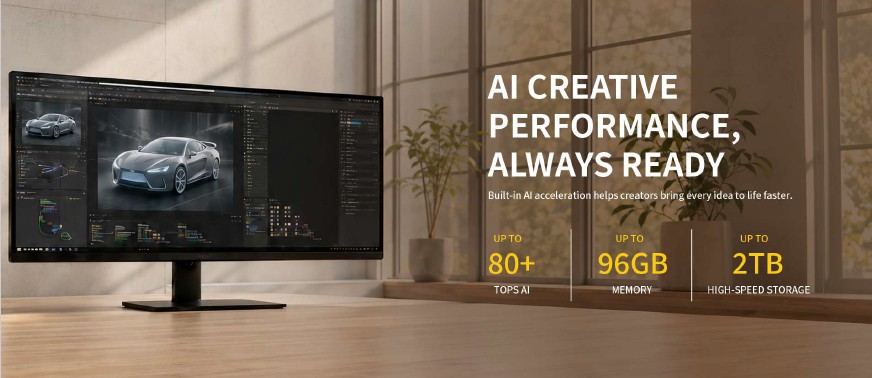
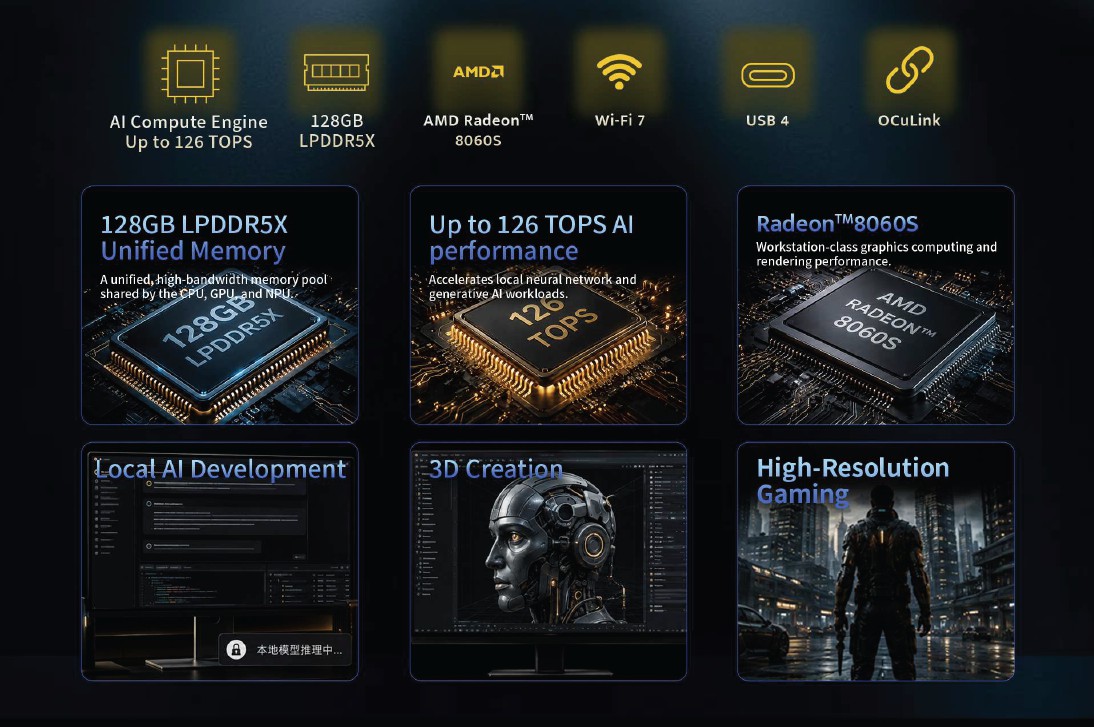
| AI Performance | Copilot+ AI (select 403 models) | Up to 80+ TOPS | Up to 126 TOPS |
| Memory | 16GB LPDDR5X, up to 64GB | 32-96GB DDR5/LPDDR5X | 128GB unified LPDDR5X |
| Storage | 512GB – 2TB NVMe PCIe Gen4 | Up to 2TB NVMe PCIe Gen4 | Up to 4TB NVMe PCIe Gen4 |
| Wired networking | RJ-45 x2 | RJ-45 x2 | Dual 10GbE |
| Wireless | Wi-Fi 6 + Bluetooth 5.2 | Wi-Fi 7 + Bluetooth 5.4 | Wi-Fi 7 + Bluetooth |
| Expansion | USB 3.2 Gen2 | USB4 + HDMI 2.1 + OCuLink | USB4 + OCuLink |
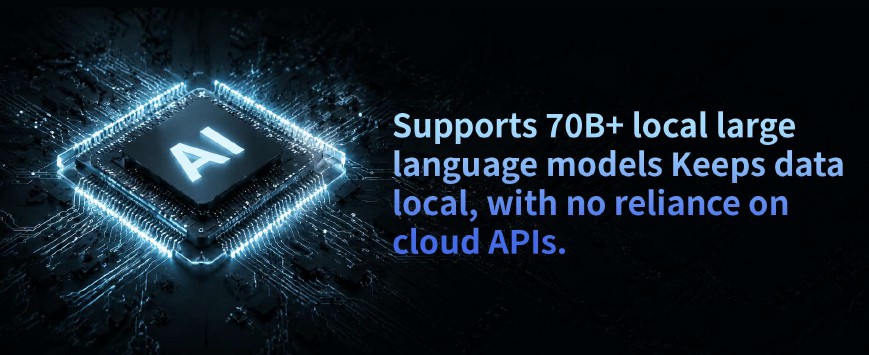
The real technical headline is unified memory. On the Core Apex, we’re talking 128GB of LPDDR5X shared between CPU and GPU, enough to run 70-billion-plus parameter language models entirely locally — with no dependence on a cloud API, no monthly bill in dollars, and above all, no sensitive data ever leaving the country. For a startup handling customer data, a law firm, a bank, or a hospital, that data sovereignty argument carries real weight.
On the Pro tier, the Ryzen AI HX + Radeon 890M combo is squarely aimed at creators: video editing, 3D rendering, generative AI, all while keeping a compact footprint that frees up desk space — a real plus in Algiers’ open-plan offices, where every square meter counts.
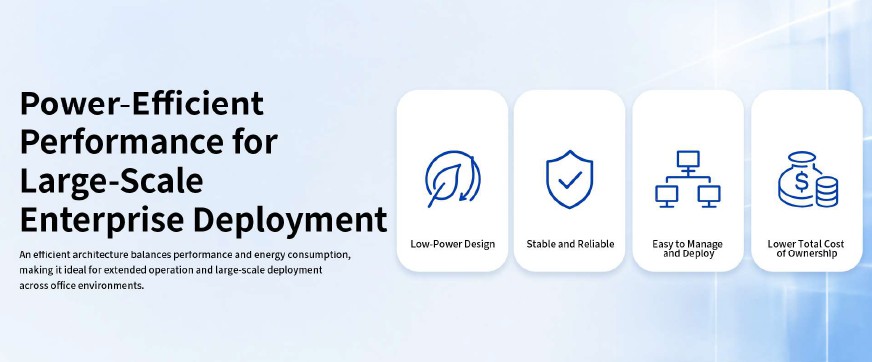
And on the Core One, the entry-level tier is far from an afterthought: low-power architecture, simplified fleet management, lower total cost of ownership — in short, everything needed to equip an SMB or an educational institution without blowing up the IT budget.
Why now is the right moment, specifically in Algeria
You could dismiss this as just another product announcement. Except the timing lines up almost too well with what’s currently happening in the Algerian ecosystem.
In April 2026, Algeria inaugurated its first-ever national startup cluster dedicated to artificial intelligence and cybersecurity at Sidi Abdellah, bringing together startups, universities, and research centers around shared projects — a step authorities described as the shift from scattered incubation to a genuine hub strategy. CERIST followed in May with the launch of a Deeptech Innovation Hub, designed to turn advanced research into commercially viable companies.
The numbers follow the same trajectory. Algeria’s AI market is projected to reach roughly $1.69 billion by 2030, up from $498.9 million in 2025 — a compound annual growth rate of nearly 28%. More than 7,800 companies are now registered on the startup.dz platform, with about 2,300 officially labeled, and a national target of 20,000 labeled startups by 2029. Algeria has even set an explicit national goal: AI contributing 7% of GDP by 2027, as part of its National Digital Transformation Strategy.
In other words: the state is structuring the ecosystem, funding is starting to mobilize (Algérie Télécom has committed roughly $11 million to fund AI, cybersecurity, and robotics startups), and the talent is already there — from developers to researchers returning home to be part of this momentum.
What was missing, very concretely, was the hardware: a machine capable of running AI locally, at a price that doesn’t spiral along with the RAM market. That’s exactly where Antec fits into the Algerian equation — right as hardware, not willingness or skill, becomes the limiting factor.
Antec’s real advantage may be smarter than the specification sheet
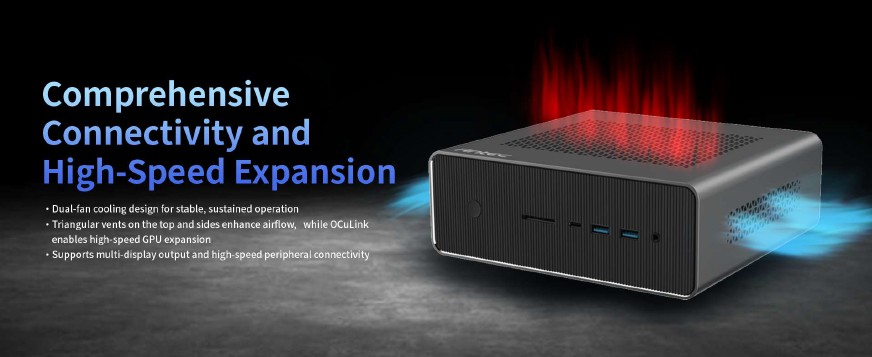
Antec is already a familiar name in the PC hardware industry, particularly in cases, power supplies and thermal engineering. That experience becomes relevant when a manufacturer attempts to put high-performance components into a much smaller chassis. Compact computing is fundamentally a thermal engineering problem.
A powerful processor can generate considerable heat. Memory generates heat. Storage generates heat. Sustained AI workloads can keep those components under load for considerably longer than a typical office application. A Mini PC that looks impressive on a specification sheet but cannot sustain its performance under prolonged workloads would have limited value for a professional user.
This is why the cooling architecture, acoustic behavior and sustained performance of these machines will be just as interesting to evaluate as their processor specifications and for Antec, this is an opportunity to demonstrate that its experience in PC thermal and mechanical design can translate into a new category.
CHB Algeria is the official and exclusive distributor of Antec
Three series, three budgets, one goal: making local AI computing accessible right as the most basic component — RAM — has become the scarcest. For Algerian project founders and startups looking to experiment, train, and deploy AI without depending on the cloud or breaking the bank on components, the window is opening.
With this upcoming launch, CHB Algeria reaffirms its commitment to driving the Algerian hardware market to new heights. As the official representative of Antec in Algeria, we are proud to bring you the best of global innovation at the right price, backed by premium local customer support.
Stay tuned.